
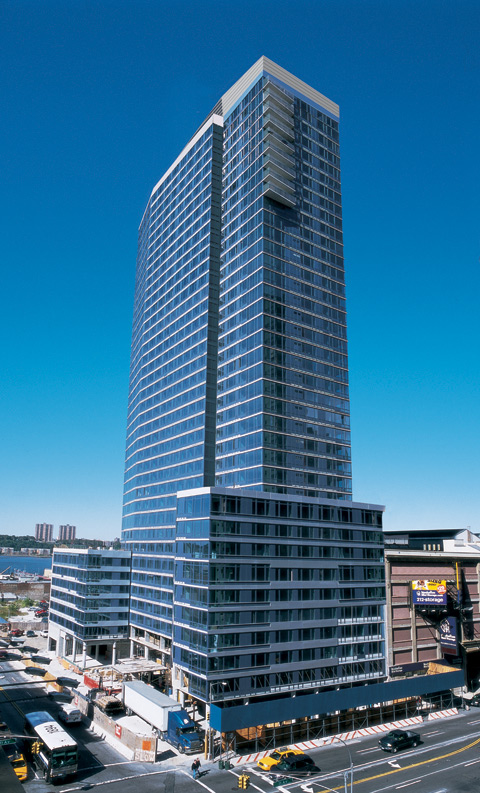
 Photo Credit: Dagher
Helena 57 West
PROJECT HIGHLIGHTS
- Location: New York, NY
- Owner: The Durst Organization
- Architect: Fox & Fowle Architects
- Area: 600,000 sq. ft.
- Completion Date: 2005
Trend-Setting High-Rise Residential Building on Manhattan’s West Side
This 38-story residential building in Manhattan’s Midtown West neighborhood contains almost 600 apartments—many with expansive Hudson River views—and several tenant amenities. The project also includes two levels of underground parking and ground floor retail space. Developed with sustainability as a primary goal, the building incorporates many green features that were ahead of their time and resulted in LEED Gold certification.
Hudson River Location Influences Foundation Design
Helena 57 West is framed entirely with reinforced concrete. The foundation consists of a mat, spread footings, two-story perimeter walls, and slabs on grade. Due to the site’s proximity to the Hudson River, the water table is high and resulted in large hydrostatic forces on the foundation elements; rock anchors were used to resist uplift. Waterproofing and an under-slab drainage system protect the parking levels from water infiltration.
Effective and Efficient Use of Reinforced Concrete
Flat plates, supplemented by beams where necessary, are used for the floors, which are supported by columns and shear walls. The building’s relatively narrow width made coordination of columns and shear walls with apartment layouts critical. Building setbacks and large amenity spaces required column transfers that did not interfere with ceilings. Cantilevered balconies at each end of the tower were carefully detailed to facilitate waterproofing and maximize durability.
Laying the Groundwork for Sustainable Concrete
For a prior project in the early 2000s, the owner commissioned Severud to perform an investigation of cementitious replacement materials, with a focus on ground, granulated blast furnace slag (GGBFS), a waste product from steel mills that has cement-like properties. Cylinder testing and petrographic analyses showed that high rates of substitution of GGBFS for cement significantly increase concrete strength and durability with only minor impacts to placement, finishing, and setting.
High GGBFS Substitution Sets New Concrete Standard
All concrete for Helena 57 West contains 45 percent GGBFS. A mock-up panel of a typical floor slab was placed at grade to test finishing of the top surface, with no serious issues encountered. In fact, over many months of construction, there were very few problems. By the end of the project in 2005, the concrete supplier was so impressed by the results that they updated their standard mix designs and storage facilities to incorporate only blast furnace slag.
Other Substantial Sustainability Features
The building incorporates other substantial sustainability features that contribute to its LEED Gold rating. An on-site treatment plant processes more than 40,000 gallons of wastewater per day to reduce demands on public utilities; heavy equipment loads and storage tanks impacted the structural design. The main roof is planted with grass to collect rainwater and provide welcoming outdoor space for tenants. A steel-framed entrance canopy is clad with photovoltaic panels.
Conclusion
Helena 57 West is an excellent example of Severud’s contributions to best practices in residential structural building designs that are practical, economical, and sustainable. The firm’s research set new standards for reduced-carbon concrete utilizing blast furnace slag. Studies into the efficacy of ground glass pozzolan as a replacement for cement begun in the mid-2010s have led to similar successes for other projects, such as the Halletts Point development in Queens.